Introspection of the current economic standing of India: Analysis

Hello Folks!

The year 2020 has been tough on us up till now. Everything seems to be so negative as if we can sense pessimism everywhere, be it in our Media, Bollywood, Markets or Economy! The only silver lining is, it has given us all an opportunity to introspect on our lives & this is going to help us a long way!

We know things happening around us are not perfect in fact they are scary at times which paints a gloomy picture of what future has saved for us!

This comes with Moody’s announcing a downgrade on India’s sovereign bonds from Baa2 to Baa3. Now, what it exactly means? Why was the downgrade done? Also, can we afford to ignore this downgrade just because now Moody’s has brought the rating down to the level at which S&P & Fitch had rated? Let’s find out!

Now first things first, Moody’s has downgraded the Long term “Issuer” ratings for foreign & local currency, Long term Senior Unsecured Debt (Local Currency) & even the Short term Senior Unsecured Debt (Local Currency). And the Outlook remains Negative.

Now, what is this all about?

It is more of a consequence of a bunch of factors including pre – COVID slower growth rates, concerns on policy implementations, raising issues in the Banking & Non – Banking Financial Services sector, Increased Debt & ESG (Environmental, Social & Governance) concerns. Let’s try to make sense out of this one by one.

Pre – COVID Slowdown: The GDP growth rates have been slowing down even before the pandemic kicked in, owing to slowing demand & other factors like weakening position in Real Estate, Banking & Non – Banking credit segments, etc.
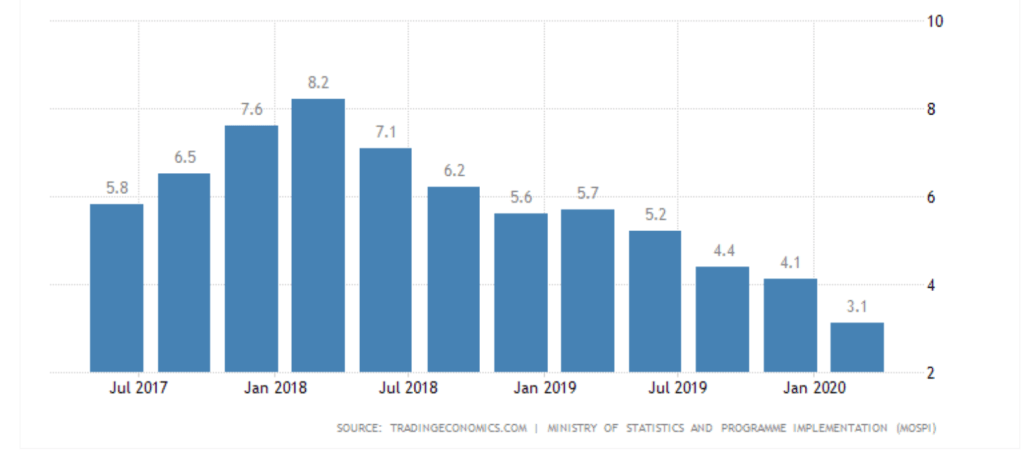
India GDP Annual Growth Rate

The graph above clearly makes the point as the data of Annual Growth Rates till January 2020. Now it does not take a rocket scientist to say that the Pandemic is going to cripple this situation further. Amidst all this, the $5 Trillion goal is going to be delayed, as GDP numbers are unlikely to rise accompanied by the depreciation of INR!

The Industrial Production Growth also corroborates the story that we were anyways heading towards a slow-down & due to the corona virus contagion, India’s Industrial production fell by 18.3% on a year on year basis, steepest decline since 1994.
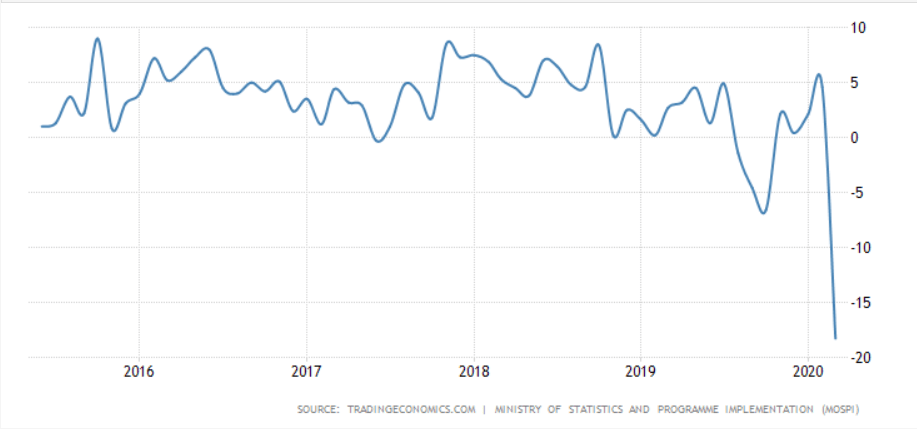
India Industrial Production

Policy Implementations: Another major reason of the downgrade was “Slow reform momentum and constrained policy effectiveness” & the rationale that the implementation of key reforms has been relatively weak and has not resulted in material credit improvements, indicating limited policy effectiveness. In other words, all new policies like GST, various programmes for MSMEs are taking a longer than expected time to yield the fruits. Political opinions aside, one should appreciate the fact that this is not entirely the fault of government, in many ways the government also has to express leniency towards the businesses when it comes to litigation & recovery of taxes; & a lot of reliefs have to be given because a lot of businesses in India still are unable to receive professional help to cope up with the new policies & of course the bureaucracy is to be criticized. If this is true, does that mean we should be unwelcoming to the new policies? Ofcourse not, as it has a lot to offer in terms of utility in the long term even though short to medium term targets are missed. That’s a whole point of being an “emerging economy” isn’t it?
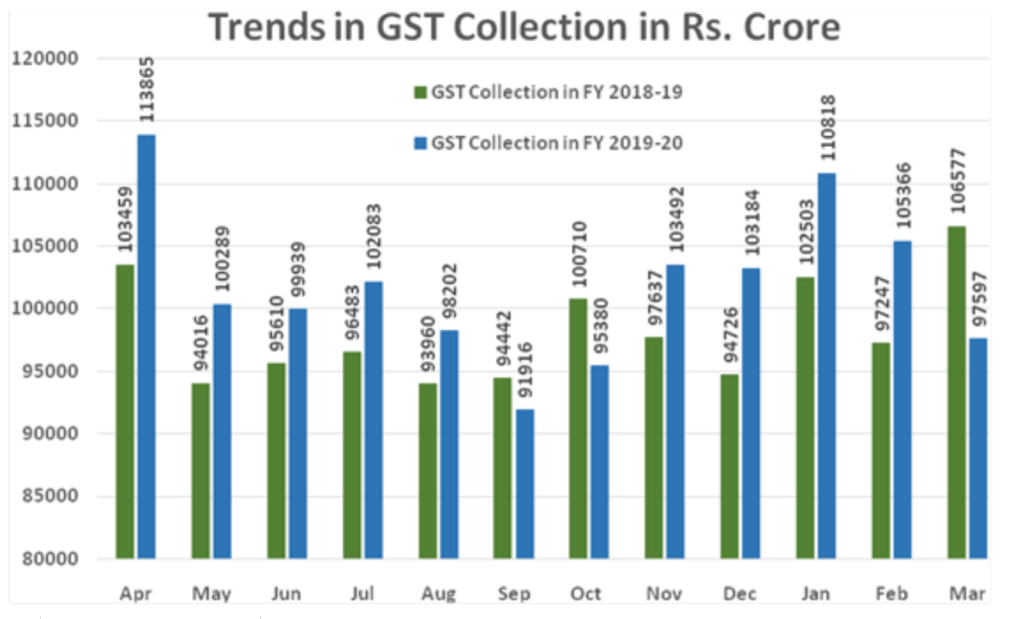
GST Collection

Source: Ministry of Finance

(GST revenues have shown a negative growth of about 4% in 2019-20)

Banking & Non – Banking Financial Sector: Despite the liquidity in the financial system infused by various measures taken by the RBI, the Banks are not lending enough – which is not helping the businesses at all. Credit Risk is at its peak, the Banks & NBFCs have become increasingly watchful of lending to avoid new NPAs on their balancesheets.  

Here, the RBI has played a pivotal role in contributing almost 8.01 lakh crores (38% of the total 20.9 lakh crore package) in the form of liquidity measures, TLTRO (Targeted Long Term Repo Operations) & rate cuts.

But for it to help the economy, Banks will have to lend more. Even the government has come up with schemes of guaranteeing some of the loans given by Banks. It would be interesting to see how it impacts the lending; and in turn, production.

NPA problems are not new to India, especially after the credit events, as that of the one happened with entities like IL&FS, Kingfisher Airlines, etc. Such issues are expected to become rampant in situations like the one’s prevailing at this time. Many prudent banks are setting aside thousands of crores of rupees in the form of provisions considering the tide of NPAs following the current COVID crisis. ∴ The MSMEs are still going to struggle for funding even though the Banks are flush with cash, as even the general interest rates go lower, credit spreads will continue to widen.
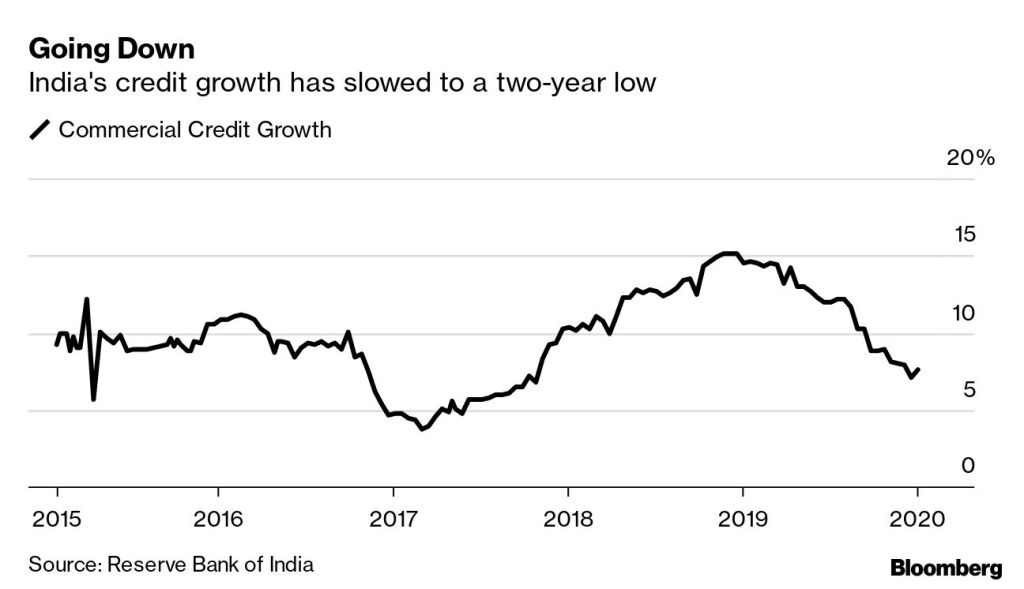
Commercial Credit Growth

Increased Debt: It’s a no brainer that India’s Debt has been rising from the past couple of years, as we are adding on more debt as compared to what we are repaying, but the Debt to GDP ratio gives us a better perspective:
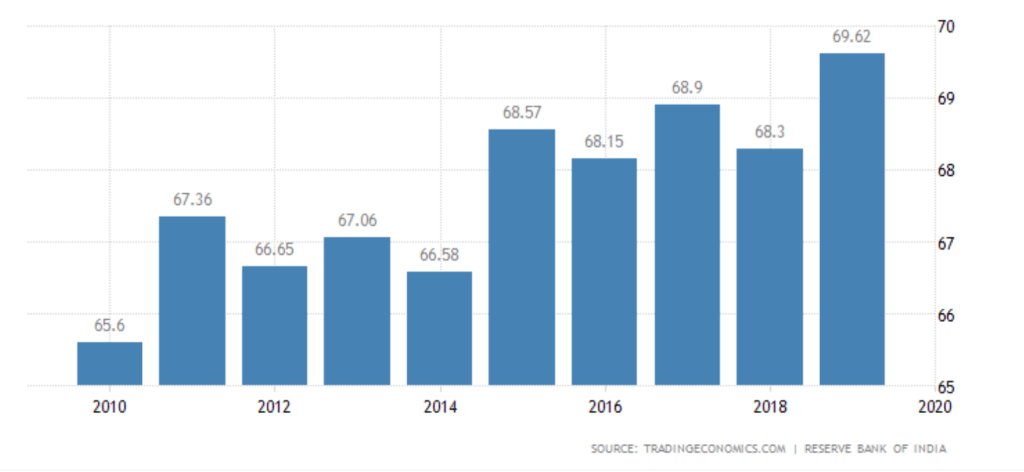
India: Debt to GDP

This becomes a problem especially in recessionary points like these, as the Debt – GDP ratio is generally considered as a measure of the country’s ability to repay its debts; and due to the slowdown, the GDP is not coming back soon, in fact CRISIL recently said in one of their reports that 10% of the GDP is permanently lost & the debt is going to rise due to slowing pace of tax revenues & increased expenditure due to the pandemic. Moody’s expects this figure to go as high as 84% of the Total GDP by the end of FY 2020.

Now let’s discuss why I have bolded the word “Generally” in the above statement, well that’s because normally, the debt – GDP ratio shows the country’s ability to repay its debt, but there have been cases where the debt – GDP has been very high, still the country is away from a default.

Like: Japan – 238% debt to GDP but its credit rating is still an A+, USA has a debt to GDP ratio of 106.9% & has a credit rating of AAA and Bonds issued by the US government are considered to be one of the safest!

However, there has been a study by the World Bank which says that a country with a debt to GDP greater than 77% for prolonged periods has a slowing growth. This is the concern.

One needs to consider such important macro-economic variables while analysing investment opportunities too, especially in times like these, as the businesses they are investing in, are also affected by the business environment which in turn has an impact due to the macroeconomic scenario at play. Economists put forth a lot of concerns about the recovery but Investors & Portfolio managers are seen to have an opportunistic view. This difference of views makes sense because after all, even though the Economy won’t have a so-called “V-Shaped recovery”, markets can. Markets are a leading indicator of the business cycle the economy is in, which means that markets can come back to a positive note before the economy will as Markets tend to discount the future.

So, all in all, it’s going to be interesting to look how the post – COVID market & economy is going to look like, how the businesses are going to be changed & the shift in the overall lifestyle of the people affecting the overall consumer behaviour as well!

Wish you all a safe time with sound holistic health in these tough times.

Remember, difficult times makes us even stronger!

Hope this was value-adding!

The Fixed Income dilemma – It’s not always what it suggests!

Hello Folks!

A lot has been already spoken about how mindful one should be while investing in the Fixed Income Markets in India, particularly in various unprecedented scenarios like the current COVID – 19 & economic stagnation.

If we observe, actually there are a lot more risks in Equity Markets, then why is fixed income discussed so largely?

The answer to this question could be – Expectation vs Reality!

This gap may turn out to be much wider if such investment decisions are not handled with care.

The term “Fixed Income Markets” provides an assurance to the investors that this avenue will give them a safe return over time. But then, on the contrary – big names like that of Franklin Templeton shut their 6 debt fund schemes abruptly! This makes the investors bewildered and wonder – is my investment really that safe as I thought it would be?

Of course, such an ambivalent thought is absolutely natural for someone looking to get safe heaven while expecting to take a ride to their dreams.

However this leads us to discover that, apparently there’s an elephant in the room and no one wants to talk about it! So by this, let’s understand where these investors go wrong.

In India, retail investors – invest in the debt markets largely through Mutual Funds. Almost all Big Fund houses have an array of categories of schemes in the Debt Segment itself. (Don’t worry, we’ll not get into these array of categories in detail) Now, each scheme has its own objective & cater to different types of investors. Most Importantly, think about this one thing whenever you are investing in any Fixed Income avenue – Safety First, Return Later!

The reason as to why I advocate this idea is – even though a lot of people are not cautious about this fact but every investor bears on some risk even if they’re investing in a Fixed Income Instrument!

One of the simplest to comprehend but yet a daunting risk is Credit Risk!

In simple words credit risk is the risk that the Lender (fund) of the money will not get repaid either partially/fully. The Credit Rating Agencies analyse the instruments and state their opinion as far as only credit risk is concerned. Generally Corporate Bonds are categorized and classified by their likelihood of performance and is rated each as AAA, AA, A, BBB, BB etc.

But when we talk about undertaking credit risk, it probably suggests that one is buying a corporate bond with a lower credit rating. But nowdays we are witnessing the bonds of companies even with an AAA & AA credit rating like IL&FS, Dewan Housing defaulting. How? And What to do about it?

First things first, a retail investor should understand and have atleast an iota of idea of why is he investing in a Fixed Income avenue?
Just to shield oneself from volatility the equity funds have, right? That is you don’t want to take on a lot of risks on this corpus. That is, you are risk-averse.

This is where investors get it wrong the most. They are expecting to have a ‘Fixed Income Investment’ but in reality, they’re actually undertaking on a lot of credit risk, which could really implode in unexpected times. Agreed that the more risk an investor bears, the more superior returns he can expect – But let me assure you, it’s not really worth it!

So, JUST SAY NO TO CREDIT RISK. FIXED INCOME INVESTING IS NOT SO SEXY, REALLY.

Instead, one could go for much stable alternatives in the same domain, probably for a fund which has less risk, like – Government Bonds, T-Bills, PSU Bonds, etc. These bonds too have credit risk but is relatively, very low.
Let’s keep credit risk funds only for institutions, shall we?

Another thing a lot of people get puzzled about is the Interest Rate Risk – Agreed, but how does it relate?

Well, what this suggests is every fund maintains a portfolio of securities and the value of this portfolio changes as a reaction to changes in the general interest rates. (Overnight Funds rate changes by RBI – REPO)
Now how much does a fund get impacted for a 1% change in the overnight funds rate is called as the Duration of the fund (Modified Duration). The Duration measures the Interest Rate Risk the fund brings with itself.

The above graph shows the effect of % change in expected prices (Modified Duration) of the bond across maturities for a % change in interest rates.
The Bond used as an example has a face value of Rs 100 & Coupon Rate @ 10% p.a payable annually.
You can observe that the % Change of price of the bond is high for a bond with longer maturity.
Please note – as interest rates fall price rises & vice versa.

To counter this risk, investors should decide the term of their corpus to sit in till maturity. We call this as an “Investment Horizon”
Then they should find a fund having a Duration equal to (or almost equal to) their own Investment Horizon.
That’s it!

Some people would continue to suggest during these times to invest in fund having a duration greater than an individual’s investment horizon. This sounds like a good idea, but again this means that you’re taking on a huge risk for a “potentially” handsome reward!

As Babu Bhaiyya suggests in here, Be like Babu Bhaiyaa.

An excerpt from an all-time popular movie – Hera Pheri

Also, now there are some investors who’re listening to the “Local Gyan” are investing in a Gilt fund.

A Gilt fund is a fund investing in Long term government instruments. Now these funds have credit risks under check but ‘Long term’ is the key term here. What I mean by this is they have a very long duration. That is, if the RBI increases the rates even slightly, these funds will be hit the most!

Nonetheless, even during these times RBI has been taking so many measures to ensure adequate liquidity in the system, one of them is lowering interest rates.

By the way, these funds’ value increase dramatically as the RBI cuts REPO rates as they have a high duration!

This is what tempted a lot of people for entering these schemes in the past couple of weeks. As a rate cut again would prove to be very profitable for them. But to everyone’s surprise, The Honorable Prime Minister of India – Shri Narendra Modi, appeared on the night of May 12, 2020 at 8:00 PM (IST) and announced a HISTORIC STIMULUS PACKAGE reckoning to be around 20 lakh crores ($266 billion) on the national television.

That’s Impressive! But how is this connected to Gilt funds?

Let me get this clear.


A huge stimulus package means a high fiscal deficit, and a high fiscal deficit means high borrowing done by the government. A high borrowing means the supply in the debt market for government bonds increases. This in turn means YTM (Yield to Maturity) will go up which means price will plummet and go down.

Also to recall, the Duration of these Gilt funds are high, so they will be the most impacted ones of all!

Of course this is a theory, but it still holds a potential, it can be accompanied by a lot RBI regulations & policies. The point I’m trying to make is – Don’t invest in gilt funds unless you have an investment horizon equal to the Duration of these funds (which is usually 8-10 years).

Also, one more blunder people resort to, is – Going for a short/ultra-short term duration fund (as this matches their investment horizon) but taking on a substantial amount of Credit Risk. This means investing in a fund that invests for short term, risky bonds.

After all these, the fund manager has to make a judgement whether the borrower will be able to raise the amount repayable to the fund by leveraging it from some another lender – because it his highly unlikely that the borrower will be potent enough to repay the entire debt amount from his own funds.

Again, this is a risk that the Fund Manager has to bear – the risk of change in perception of the market towards lending to the borrowers. If the borrower fails to raise money, then what? We all know, the answer is – He’d Default!! And these funds are still classified as short/ultra-short term funds as their durations are short.

This is the reason why there were some shorter duration schemes’ names too, along with the credit risk funds in the list of schemes shut by Franklin Templeton.

A Mutual Fund Investor needs to be on top off the portfolio, these schemes are managing.

This can be done by analysing factsheets updated by these funds on their websites. This is what a Financial Advisor is an expert at. These things have to be observed, analysed and evaluated before investing. Even by this, sometimes this analysis can get tricky. Please don’t hesitate to take professional help.

Mutual Funds Sahi Hai. Simple Nahi.

Block Chain: An Auxiliary to the prevailing BFSI sector


As we left off in the last blog, the BFSI is among the early adopters of the BlockChain Technology.

And no wonder why they are…. Why not adopt by technology rather than being disrupted by it?


Let’s quickly summarize what we had discussed in the last article:

Blockchain is highly secure.
Smart contracts are really smart.
They save time, efforts & money!

Well, we’re all ready to dive in!
The BFSI always had a fear that this technology could disrupt their business lines one by one, so they adopted & accepted & more importantly embraced the change. As they came to together in a consortium: R3 to figure out ways in which Block Chain can be used in various subsets of the Industry.

One of the ways was to, Issue Commercial Papers on Block Chain,
And yeah, it has happened in India too, Vedanta Ltd recently issued their Commercial Paper on Block Chain! (The Merchant Bank was YES Bank & fintech consultant was a New-York based start-up MonetaGo) Other than this, Block Chain has the capability of offering a wide range of Trade-Finance related solutions & they can come handy for legit business looking out for short-term financing & credit specifically being in an economy having recessionary pressures & preventing the economy to going through deceits like the Nirav Modi scam.

So how could Nirav Modi get away with such fraudulent acts?

The answer could be a high amount of TRUST was bestowed upon a person or a group of people by all the stakeholders at the PNB!


The scamster got away with it as he had these so-called trustees in his pockets.
However, the truth is if this was a Block Chain setup, the basic rules would’ve just rejected their application for LOUs every time they were made, without manual intervention & our country could’ve saved millions!
As we know that, for availing a trade finance a legit small business has to go through a strenuous process of paperwork then those documents are scrutinized and then after some time the entity gets the amount it desires to have.
Behind this a lot of manpower, man-hours are invested. A Block Chain setup saves a lot of resources here. It has the capability of making trade finance available by having much simpler processes.
It can have a check on the stock, receivables and payables of an organization on a real-time basis thus, it then helps build a trust-less mechanism for banks & thus the financing arrangements are granted on the go!

Along with this the Banks also can introduce innovative products like discounting of sales invoices on the Block Chain maybe even securitize them.
Speaking of Innovative instruments, there was a venture capital fund set up on the Block Chain called The Decentralized Autonomous Organization (The DAO) which was a pool of cryptocurrency just like any other fund & it invested in businesses, all over the Block Chain! Surprisingly the Number of Fund Managers & employees in the fund was 0.

How was it possible?

Because of smart contracts, the logic was coded in such a way that voting was conducted amongst the investors before deciding to invest in a project.


Also, there are many Crypto Asset hedge funds, which invest primarily in Cryptocurrencies
As we know cryptocurrencies have privacy as pseudonyms are used, traceability by authorities is again in question. The AUM of this industry is approximately around 1 Billion US$ now, with 55% in the Cayman Islands (Tax-haven), 17% in the US & 13% in the British Virgin Islands (Tax-haven).

What do these hedge funds do?


There are 3 sub-types in this category of Hedge Funds:


1. Fundamental


2. Quant


3. Discretionary


We have heard about fundamental analysis in equity investing, but how can one invest fundamentally in a crypto-asset which is supposed to be so volatile?
The Fundamental Crypto investors invest in ICOs & enter into SAFTs.


The terms seem to be much complex than they are but believe me, they’re not. Here’s some clarity on the definition:


Initial Coin Offering (ICO): A counterpart of IPO in the Equity market. Wherein a Business to raise funds doesn’t have to give away its ownership rights & can still raise funds by issuing ‘Tokens’ as in their own currency!
Example: A particular e-payment company comes up with an ICO wherein the customers of the company also make/receive payments in that token only. Thus there is an active market for those tokens. Now this corporation to raise funds sells these tokens to Investors.
Thus as the demand for the product rises in the market, the value goes up as the number of tokens remain the same & as more transactions happen the more liquid the market is. This makes it an attractive deal for the investor.

Simple Agreement for Future Tokens (SAFT): Counter-part of the Pre-IPO stage funding in Equity Markets. Wherein the Investor invests in the business to provide the business with funding that is required to develop the product.
But the Investor enters into an agreement with the business to provide him with the equivalent number of tokens when the token is listed on the Crypto – Exchange.
Also, the value at which the SAFT investor is allotted Tokens is generally at a discount to the price at which the ICO is listed. This is to provide the investor with an advantage for investing at the nascent stage.

Along with all these innovative products, Block Chain has a capability to disrupt the Brokerage business too as it also involves record-keeping.

Wondering, when will the storm of disruption be coming to India? Let’s cross our fingers!
But are we ready for such a change? How is the regulatory authorities’ reaction on all of this?


An interesting topic, which can be touched upon as a separate topic of discussion!
Hope this was value-adding, would love to know your thoughts in the comments section below!

Blockchain :- The Enigmatic tech of the future

BlockChain, What is the buzz all about? When we hear this term we seem to correlate it to Bitcoin, actually, they’re connected but not in the way we think! Let’s dive in!

Many of us must’ve heard people saying that Blockchain & Bitcoin are two different things, as in Bitcoin is a cryptocurrency & BlockChain is the underlying technology. Before we try to figure out what’s what, let’s understand some basic things about BlockChain: So what’s a BlockChain?

It’s simply a chain of blocks, which consists of data & some cryptographic hashes which make sure that the data stored is not tampered with. But How? So, each of the blocks along with the data consists a Hash, which can be thought of as an alpha-numeric ID to the block (Basically a primary- key) & the block also contains the Hash of the previous block. Thus creating a CHAIN! If tampering is done in a block its hash would change and this chain would break.

There always remains a risk of changing the hashes of all the blocks in the chain using computers & joining the chain again after tampering. To prevent this from happening the BlockChain run on a concept known as Proof-of-work which essentially slows down a process of creation of blocks & adding it to the BlockChain irrespective of the computational power!

What?! Slowing down a process is a part of technology?

The answer to that is YES!

As when the process is slowed down, one cannot tamper with a block and get away with re-calculating the hash of all the subsequent blocks & joining the chain again.

 Once we know this, we have to know that the BlockChain has a peer to peer distributed network. This is the reason some people also call it a distributed ledger. This is the peculiarity of the BlockChain as it adds the extra security cover. We are so used to centralization that even our transactions are approved by the central authority i.e. Banks; however, BlockChain is precisely converse to that; as its structure is peer to peer & everybody that has the requisite computational power can participate in the network & get a copy of the whole chain! This secures the network even more as all the blocks are added only on approval from all the nodes (i.e. such participants).

To summarize, in order to hack a BlockChain one would require to recalculate the hashes of all the blocks, do the proof-of-work & get control of at least 51% of the total participating computers! When even one participant does not know who the other participant is! Seems pretty difficult, right? If you think this makes BlockChain really awesome, you haven’t heard of Smart contracts! Sounds similar to Smartphones, but believe me they’re smarter!

Smart contracts are basically contracts which are coded in such a way that when the conditions mentioned in them are satisfied, they’re executed, they even move money from one person to another! Their existence is one of the reasons why BlockChain has become so famous! So much time we have invested in understanding BlockChain but I haven’t mentioned cryptocurrency much (which runs on BlockChain, at least as they say!) 

The truth is – A BlockChain is as dependent on a cryptocurrency as a cryptocurrency is on a BlockChain.

This might be confusing, let me get it clear :-

As I said earlier, that BlockChain is based on a peer-to-peer network & that anyone can be a part of it & get a full copy of the BlockChain.

At the cost of repetition, this helps increase the security as now all the participants have to agree on a transaction before it gets in the block. However, some questions remained unanswered that why would the participants do all this? What is this trouble for? The answer is very very simple! They are rewarded, by paying them cryptocurrency! The participants are called miners, & the process of checking a transaction before adding it in a block is called mining!


Fun Fact: There are only 21 million Bitcoins in total & 2 million of them are not mined yet as Satoshi Nakamoto the founder of Bitcoin has saved it for the future. Now if it has to be asked who really Satoshi Nakamoto is, that would be a really difficult question. On a lighter note: some say Elon Musk is Satoshi Nakamoto!

Getting back, The BlockChain is supposed to be the revolution across all industries, it’s in a nascent stage of development but has a capability of doing a lot more than it’s expected to do.

Some people would still have a question in their minds as to, WHY BlockChain?

The answer to that would be :-

1. Saves time

2. Saves efforts

3. Saves MONEY!

An example could be: in a manufacturing of tomato sauce, if the tomatoes purchased from one farm were poisonous then a BlockChain has a capability to locate the bottles which contain the sauce from those tomatoes by just track back through the blocks in the BlockChain & provide you with the exact batch number & location of those bottles in literally no time! This thing would normally require days in a normal setup. It can also be used for the voting process, as in the citizens can vote to elect a government in the BlockChain network, this specifically will be welcomed in Indian context as then politicians claiming that EVMs are hacked will not be able to have any kind of baseless argument, knowing the nature of security in a BlockChain.

Its existence is being developed in the shipping & logistics space as well, also is a great measure to maintain land records of a state- so that we can have a definite title of the land and can know a lot more about the land, Building appurtenant, is it agricultural land, who held the title earlier, whether it is mortgaged, when was the last time it was renovated, and a lot more other information, This is currently used by the state of Andhra Pradesh!


The point is it has the capability of providing actionable data & thanks to smart contracts it also has the capability to act on it! It is expected to be a major disruptor in the BFSI (Banking & Financial services industry), the BFSI is among the early adopters of the BlockChain technology.

A very interesting topic which can be touched upon as a separate topic for discussion!

Hope this was value-adding, would love to know your thoughts in the comments section!

Design a site like this with WordPress.com
Get started